
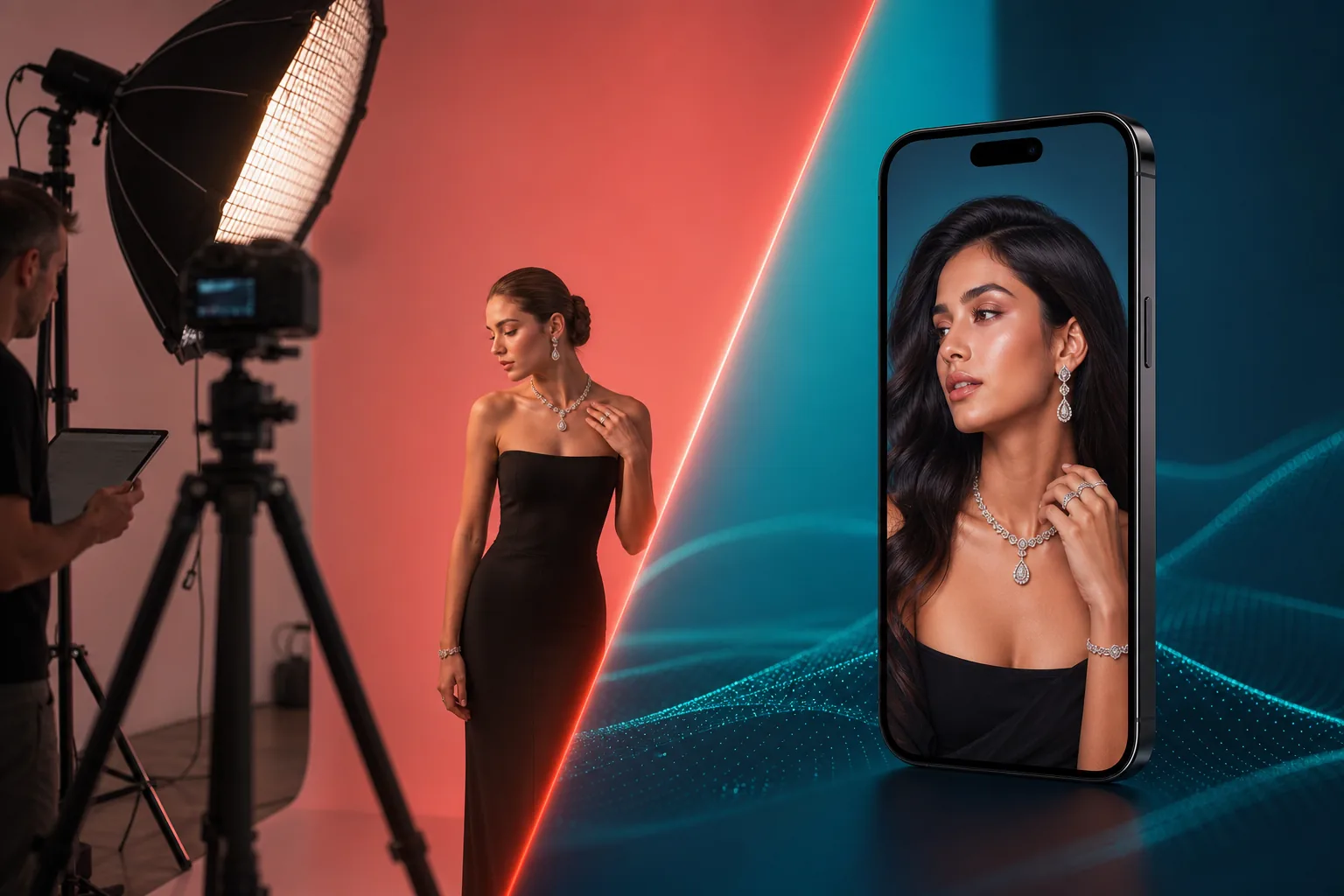
If you've scrolled through Instagram or YouTube lately, you've probably seen product videos that look like they were shot on a professional set — a model wearing jewellery in golden light, a perfume bottle held just so, a hotel suite that feels cinematic. What you might not realise is that a growing number of these visuals aren't from traditional photoshoots at all. They're created with AI models, and in 2026, that shift is reshaping how small brands compete with big ones.
| Factor | AI model video | Traditional shoot |
|---|---|---|
| Typical cost (India SMB) | Fraction of studio budget | ₹50,000–₹2,00,000+ |
| Turnaround | 24–72 hours | 2–4 weeks |
| Revisions | Scene & mood changes without reshoot | Often requires rebooking crew |
| Best for | Reels, ads, WhatsApp catalogs | Hero print campaigns, editorial |
| Usage rights | Full commercial on delivery (Tegvo) | Varies by contract |
What is an AI model, exactly?
An AI model is a hyper-realistic digital human generated by artificial intelligence. Unlike stock footage or generic templates, a skilled studio can tailor the model's appearance, outfit, setting and actions to match your specific product and brand. Send photos of your necklace, and the AI model can "wear" it in a bridal campaign. Send your perfume bottle, and it can appear in a luxury bathroom scene — no photographer, no studio rental, no model casting.
The technology has matured quickly. Early AI visuals looked uncanny; today's best outputs are indistinguishable from professional shoots to the average viewer, especially in short-form video where motion and lighting do heavy lifting.
Why brands are making the switch
The appeal isn't just novelty — it's economics and speed. A traditional product shoot for a jewellery brand might cost ₹50,000–₹2,00,000 once you factor in studio time, photographer fees, model rates, makeup, styling and post-production. Turnaround is often two to four weeks. AI model videos typically cost a fraction of that and deliver in 24–72 hours.
Four reasons brands choose AI model videos:
- Cost: No studio, no crew, no model fees — just your product photos and a brief.
- Speed: Launch campaigns in days, not weeks. Test multiple concepts without rebooking.
- Flexibility: Change outfits, backgrounds and moods without reshooting. One product, ten looks.
- Rights: Reputable studios include full commercial usage rights on delivered videos.
"The question isn't whether AI can replace every photoshoot — it's whether you can afford to ignore a tool that delivers 80% of the quality at 20% of the cost."
Real use cases that work today
Jewellery: Small designers and regional jewellers use AI model videos for festive collections, bridal sets and everyday pieces. The model showcases scale, movement and sparkle — critical for high-consideration purchases.
Hotels and travel: Boutique properties create walk-through style promos showing rooms, amenities and ambience without flying in a production crew. Short cinematic clips perform well on Instagram Reels and booking platforms.
Beauty and perfume: Brands test ad creatives rapidly — different settings, moods and model styles — before committing budget to a full campaign.
General product launches: Any physical product that benefits from being held, worn or placed in context can work. Fashion, accessories, food packaging, electronics — the list keeps growing.
Curious how it works for your product?
See how our AI model videos work →Transparency matters
AI-generated content comes with responsibility. Ethical brands and studios are clear that visuals are AI-created — not misleading consumers into thinking a real person endorsed a product they didn't. Regulations are evolving, but the best practice today is simple: represent AI content honestly, use it for commercial purposes you're licensed for, and avoid deceptive claims.
At Tegvo, every AI model video we deliver is clearly produced with AI, and we include full commercial rights so you can use it across your channels with confidence.
How to get started
You don't need to understand the technology deeply — you need good product photos and a clear brief. Here's a simple path:
- Gather 3–5 high-quality photos of your product (clean background, good lighting).
- Write a short brief: what's the mood? Who's the audience? Any reference videos you love?
- Reach out to a studio like Tegvo on WhatsApp with your photos and brief.
- Review the draft, request reasonable revisions, and receive your final video with usage rights.
Most custom AI model videos deliver within 24–72 hours. That's fast enough to ride a trend, launch before a festival, or test an ad before scaling spend.
Why Ahmedabad & Gujarat businesses are adopting AI video first
From CG Road jewellers and SG Highway retailers to Surat textile exporters and Ahmedabad boutique hotels, Gujarat brands compete on WhatsApp and Instagram — not billboards. Searches like “AI video studio Ahmedabad”, “product reel maker Gujarat” and “affordable promo video India” reflect real demand from SMBs that need agency-quality output without Mumbai-level budgets.
Tegvo is based in Ahmedabad and works with clients across Gujarat and India. You send product photos on WhatsApp; we return cinematic 9:16 reels with full commercial rights — usually within 24–72 hours.
The bottom line
AI models aren't replacing every photographer or every shoot — nor should they. But for brands that need professional product visuals on a realistic budget and timeline, they're no longer a futuristic experiment. They're a practical tool that's already here. If you're still waiting for the "right time" to try AI content, 2026 might be the year your competitors stop waiting.
Frequently Asked Questions
What is the difference between an AI model video and a traditional product photoshoot?
A traditional photoshoot requires a physical crew — photographer, model, stylist, makeup artist, studio rental and post-production editing — which takes 2–4 weeks and costs ₹50,000–₹2,00,000+ for a brand in India. An AI model video uses your product photos as input and generates a hyper-realistic AI model wearing or holding your product in a custom-designed scene. Turnaround is 24–72 hours at a fraction of the cost. For Instagram Reels, WhatsApp catalogs and Meta ads, the output quality is competitive with traditionally produced content.
Which product categories work best with AI model videos?
AI model videos are particularly effective for jewellery (shows movement, sparkle and scale), ethnic and fashion wear (shows drape and styling), perfume and beauty (premium mood and lifestyle scenes), hotel and restaurant promo (ambience walkthrough), and D2C physical products that benefit from lifestyle context. Categories that require demonstrated mechanical function or industrial precision may still benefit from traditional product videography for those specific shots, supplemented by AI for lifestyle and social formats.
Can small businesses and independent sellers use AI model videos?
Yes — AI model videos were specifically designed to democratise access to professional product visuals that were previously only affordable for large brands. Independent jewellers in Ahmedabad, ethnic wear sellers in Surat, D2C perfume brands in Gujarat and home-based product sellers across India all use AI model videos to publish content that competes visually with national brand campaigns. The entry cost is accessible for individual sellers, not just established brands.
How do I get started with AI model videos for my products?
The process is straightforward: (1) Take clear product photos — front, side and close-up of key details, ideally against a plain background with good natural light. (2) Write a short brief describing your target buyer, the mood you want, any reference reels whose pacing you like, and the platform the video will run on. (3) Message a studio like Tegvo on WhatsApp with your photos and brief. Most simple product briefs receive a quote and first draft within 24–48 hours.
Are there any products that AI model videos cannot handle?
AI model videos work best for products where visual representation — appearance, lifestyle context, movement — drives purchase decisions. They are less suitable for products requiring technical demo videos (complex machinery, software interfaces), highly regulated categories needing compliance-specific content, or situations where a real celebrity endorsement or specific individual's identity is contractually required. For the vast majority of consumer product categories — jewellery, fashion, beauty, food, hospitality — AI video is fully capable.
What does "full commercial usage rights" mean for AI model videos?
Full commercial usage rights mean you are licensed to use the delivered video file across all commercial channels without additional payment — including Instagram Reels, WhatsApp Status, Meta paid ads, Google Display ads, YouTube, website embeds, email marketing and WhatsApp broadcast lists. You are not renting the video for a limited time; you own the right to use it commercially. Always confirm the specific rights terms with your studio in writing before payment — Tegvo includes commercial rights documentation on request.